 Orderlynetwork
 connects perpetual DEXs to a shared orderbook
Orderlynetwork supplies a shared orderbook for decentralized exchanges (DEXs) that offer perpetual futures contracts. These derivatives track an asset's price without requiring ownership of the underlying asset. Builders supply the trading interface and set user fees. Behind that interface, an off-chain engine matches orders, while blockchain contracts handle vaults and settlement. Traders access this infrastructure through an Orderly-powered DEX, with supported-chain connections to common liquidity for the same market.
Matching, vaults, and settlement divide the work
The matching engine handles order execution off-chain, while vault and settlement contracts manage collateral custody and the resulting trading records. The central limit orderbook organizes buy and sell interest by price. The engine matches compatible orders using price-time priority; matched trade data is then uploaded in batches to Orderly L2 for settlement, and LayerZero carries messages for deposits, withdrawals, and balance updates. Vaults hold assets on supported chains without requiring collateral to move between chains for every order.
Trading keys authorize orders. Users sign requests with private trading keys, and the protocol verifies signatures against registered public keys before matching. Keep the private trading key secure. The protocol has also undergone multiple security audits.
The EVM omnichain architecture launched on November 1, 2023, with its first vault on Arbitrum.
Shared liquidity connects supported chains
Shared liquidity gives supported EVM chains and Solana access to a common orderbook for the same standard market. EVM means Ethereum Virtual Machine. Chain choice therefore doesn't require a separate orderbook for each connected network. Depth changes as participants place and execute orders, and builders retain their own fee settings. Builder-operated Perp Anything markets have separate orderbooks, so markets tracking the same underlying asset don't necessarily share liquidity.
Trading access depends on the DEX and the market
An Orderly-powered DEX provides the trading interface and wallet connection through which a trader accesses perpetual markets and deposits supported collateral. The Live DEX Board identifies available interfaces. Deposit access requires a supported chain and an asset that the chosen interface accepts. Perpetual futures have no expiry date and allow long or short exposure. Leverage increases both gains and losses relative to collateral, making the market's margin and liquidation rules relevant to an open position.
Standard markets support cross margin and isolated margin. Cross margin shares collateral across cross-margin positions; isolated margin assigns margin to a particular position. The mode changes which collateral supports the position. Maximum leverage also varies by market.
Contracts quote and settle in USDC. Eligible non-USDC assets can support margin under multi-collateral rules. Chain-specific caps and valuation weights limit usable collateral, and borrowing or loan-to-value thresholds can trigger conversion into USDC.
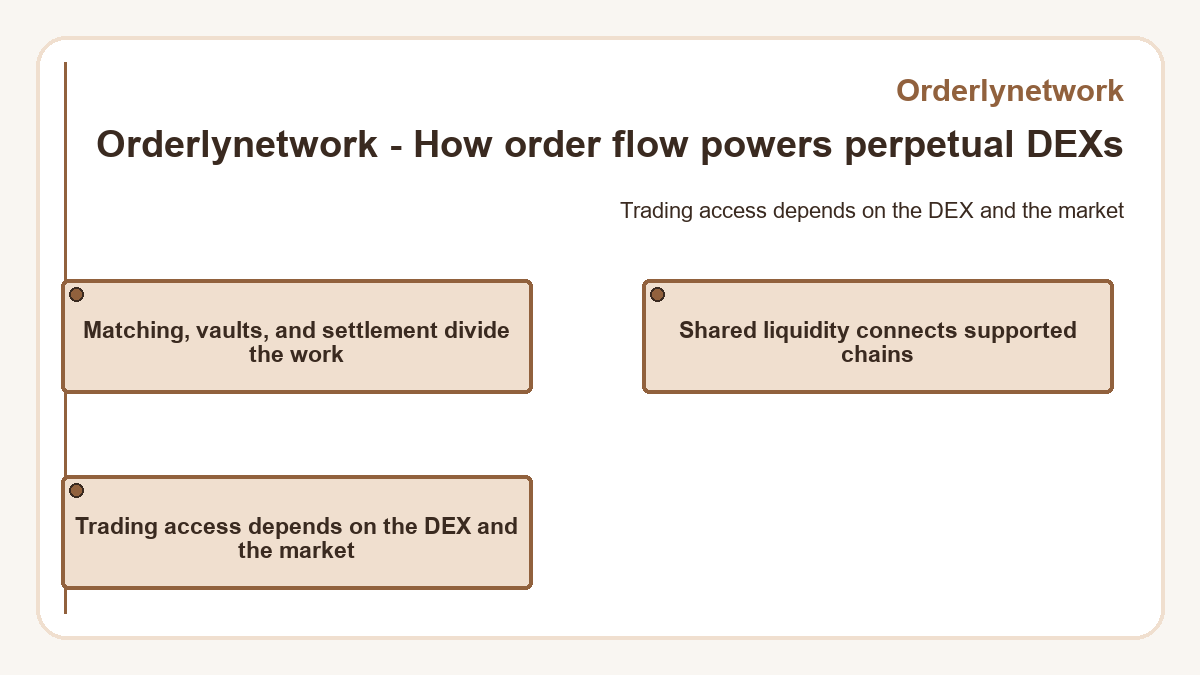
Orderlynetwork - How order flow powers perpetual DEXs
- Matching, vaults, and settlement divide the work
- Shared liquidity connects supported chains
- Trading access depends on the DEX and the market
Perp Anything lets individual builders operate markets labeled Community Listed. These markets use isolated margin only and have separate symbols, orderbooks, and risk parameters from standard markets, with liquidity that depends on the builder's market-making arrangements and insurance coverage that comes from assigned builder-managed funds. Markets assigned to the same fund share its coverage. They don't receive the standard platform backstop. A frontend may display all, selected, or none of these markets, so the operating builder and the market's risk disclosure matter alongside the asset name.
Builders choose templates or custom integrations
Orderly One provides a template-based launch path. Templates offer branding and built-in configuration options. Builders can use the SDK and API to create a custom trading interface. That path gives control over the frontend and requires development resources. Orderly One handles builder onboarding for both approaches; creating its template frontend is optional for an SDK integration.
Customization can include cross-chain swaps, points programs, trading competitions, leaderboards, and referral systems. A particular DEX's implemented features determine what its users encounter. Access to the underlying infrastructure doesn't imply that every frontend exposes every available feature.
The same orderbook infrastructure supports aggregators, trading bots, and hedging solutions, so an integration can focus on a particular trading function.
Builder registration includes a profile, a broker ID, and an admin account. The broker ID identifies the platform; admin registration completes setup and enables management of builder settings and platform earnings.
Which order instruction fits the trade?
The order instruction sets execution constraints on the shared book, including price boundaries, immediacy, maker status, and position reduction. A LIMIT order constrains price; POST ONLY requires maker treatment.
- Use MARKET for immediate execution at available prices; remaining quantity cancels if book liquidity or the applicable price limit prevents completion.
- Choose LIMIT when execution must occur at a specified price or better; an acceptable fill isn't assured.
- Use IOC, or Immediate or Cancel, when an immediate partial fill at the specified price is acceptable; any unfilled quantity cancels.
- Choose FOK, or Fill or Kill, when the full quantity must execute at the specified price; otherwise, the whole order cancels.
- Use POST ONLY for maker treatment; the order cancels if it would immediately match visible resting liquidity.
- Choose REDUCE ONLY when the order must decrease an existing position without opening or increasing one.
A LIMIT order can execute immediately when an acceptable price is available. Setting a limit therefore doesn't itself require maker treatment.
ORDER links staking with protocol participation
ORDER is the governance and utility token, and holders can stake it to participate in protocol revenue sharing. Governance participation includes votes through Snapshot. Staking ORDER accrues VALOR, a non-transferable measure that represents a share of the protocol treasury. The treasury's value and the holder's available VALOR relative to circulating VALOR determine that entitlement. Trading collateral supports open positions; staking accrues treasury entitlements.
Builder staking also serves a pricing function. Builders can qualify for lower base-fee tiers through ORDER staking or monthly volume, under the applicable tier requirements.
The DEX fee differs from the protocol base fee
The builder's protocol base fees follow its applicable tier. Each builder sets its user-facing trading fee rates. That fee must meet the applicable base-fee requirement. Shared orderbook access therefore doesn't establish a universal trading rate across DEXs.
Trading fees use basis points of the trade's total value, and perpetual trading fees are charged in USDC. The protocol factors them into the position's average entry price. In a visible-book match, the resting order provides maker liquidity, and the incoming order takes liquidity. Hidden-liquidity matches have a specific classification rule. A LIMIT instruction alone doesn't establish which fee applies. Maker rates can be negative when the builder configures a rebate within its eligible tier. Protocol-funded rebates pass through to traders and don't become builder revenue.
Where a trading fee is charged, the trader sees one configured fee; the protocol base fee isn't stacked on top. For taker trades, the builder retains the margin above the base fee. Comparing interfaces therefore requires the user-facing rate for the intended fill type, alongside the market's available depth.
Orderlynetwork: frequently asked questions
What does the broker ID setup fee cover?
The one-time $10 setup fee creates a builder's broker ID, which identifies its platform. It applies to both template and SDK builders. Creating the initial profile is free, and obtaining the ID doesn't complete onboarding: admin-account registration is also required. Custom development and third-party operating costs remain separate.
Does Mainnet builder registration also register the builder on Testnet?
Mainnet registration doesn't carry over to Testnet. A builder must register separately in the Testnet version of Orderly One to test an integration.
Do API traders need to complete builder onboarding?
API traders using an existing builder's trading platform don't need to complete builder onboarding. That registration process applies to launching and administering a platform.
Is a Post Only order canceled when it matches hidden liquidity?
A Post Only order retains maker treatment when it immediately matches only hidden quantity. In that case, the incoming order is the maker, and the resting hidden order is the taker. Immediate matching against visible quantity triggers cancellation instead.
When did ORDER launch?
ORDER launched in August 2024. That token launch was separate from the November 2023 EVM omnichain infrastructure rollout.
How do governance voting and protocol upgrades differ?
Governance participation includes voting through Snapshot, while protocol updates require approval through a multisignature mechanism.
Can a token project receive a listing without a listing fee?
Qualifying token projects can receive a listing without a listing fee. Standard listings require evaluation and approval. Perp Anything is the separate builder-operated route, with its own setup, liquidity, and risk-control requirements.
Are orders private because matching happens off-chain?
Off-chain matching keeps order submission out of a public blockchain mempool before execution, but the operator and matching infrastructure can read the full request. Matched trade data becomes public after inclusion on Orderly L2; Ethereum also publishes the batch data. Unmatched and canceled orders aren't included in the settlement batch.