 Orderlynetwork
 requires sustained depth before Perp Anything markets open for full trading
Orderlynetwork requires Perp Anything markets to sustain qualifying bid and ask depth for 10 uninterrupted minutes before they can accept market orders. Each side must meet its network's threshold within the ±5% band. Builders also need adequate Insurance Fund coverage and valid price sources.
Launching a builder-operated perpetual market
Perp Anything lets a builder launch a perpetual market in Orderly One while taking responsibility for its price sources, liquidity, and risk coverage. The contract tracks an underlying price without giving traders ownership of the underlying asset. The builder chooses the asset, configures supported trading parameters, and arranges market-making. Orderlynetwork supplies matching, liquidation, settlement, and automated operating controls. These markets appear as Community Listed, with the operating builder identified. The feature serves long-tail assets and community-specific demand that need a builder-controlled listing. Those choices remain subject to supported asset, price-source, and risk rules.
Builder Admin access is a launch prerequisite. A broker ID alone doesn't complete setup; the admin account must also be registered. Market management takes place in Orderly One. Operational readiness includes the fund assignment, liquidity, configured parameters, and alerts.
Quotes on both sides control the opening window
A market in
POST_ONLY
accepts limit orders to build liquidity, then becomes eligible for
ACTIVE
after sustained depth on both sides.
ACTIVE
permits full trading, including market orders. The qualifying quantity is orderbook depth inside the monitored ±5% band, expressed in USDC. Bid and ask depth count separately. Adding them together would conceal a weak side of the book. Depth outside the band doesn't satisfy the monitored requirement.
If either side falls below its Depth Warning threshold during the launch window, the 10-minute timer resets. Both sides must continuously meet or exceed the applicable threshold. A single qualifying snapshot doesn't demonstrate an uninterrupted hold. The completed window permits the transition to full trading, provided the market's other operating conditions remain satisfied.
Network parameters set different launch boundaries
Mainnet and Testnet use different funding and depth settings, so a test launch doesn't establish compliance with the production liquidity requirements. The configured parameters apply to the network where the market operates. Depth Warning governs opening; Depth Limit governs the lower liquidity floor after launch.
| Parameter | Mainnet and Testnet settings | Condition applied |
|---|---|---|
| Insurance Fund requirement | Mainnet: 25 000 USDC; Testnet: 100 USDC | Assigned balance must exceed the requirement multiplied by the effective-symbol count. |
| Depth Warning | Mainnet: 25 000 USDC; Testnet: 500 USDC | Each side must meet or exceed this depth throughout the opening window. |
| Depth Limit | Mainnet: 12 500 USDC; Testnet: 250 USDC | Either side below this floor can trigger trading restrictions. |
| Depth measurement band | Both networks: ±5% | Bid and ask depth are checked separately inside this band. |
| Depth hold window | Both networks: 10 minutes | Any dip below Depth Warning restarts the full window. |
Insurance Fund coverage follows assigned symbols
The Insurance Fund balance requirement scales with every effective symbol assigned to an account, and its balance must exceed the resulting requirement. The rule is
IF balance > IF Requirement × n
, where
n
is the number of effective symbols assigned to that account. Funding exactly at that product doesn't satisfy the rule.
Coverage during setup and restricted trading
The accounting includes markets in
NEW
,
PENDING
,
POST_ONLY
,
ACTIVE
, and
REDUCE_ONLY
. Symbols in
DELISTING
or
DELISTED
don't count toward this requirement. A pre-launch market therefore requires coverage before full trading begins. Restricting a market to position reductions doesn't remove its fund requirement. Adding another effective symbol increases the balance that its assigned account must exceed.
Account boundaries
Markets assigned to one fund
Each effective symbol must be assigned to exactly one Insurance Fund account, although that account can support multiple symbols whose losses can reduce the coverage available to others assigned to the same fund. Separate orderbooks don't, by themselves, establish separate insurance coverage.
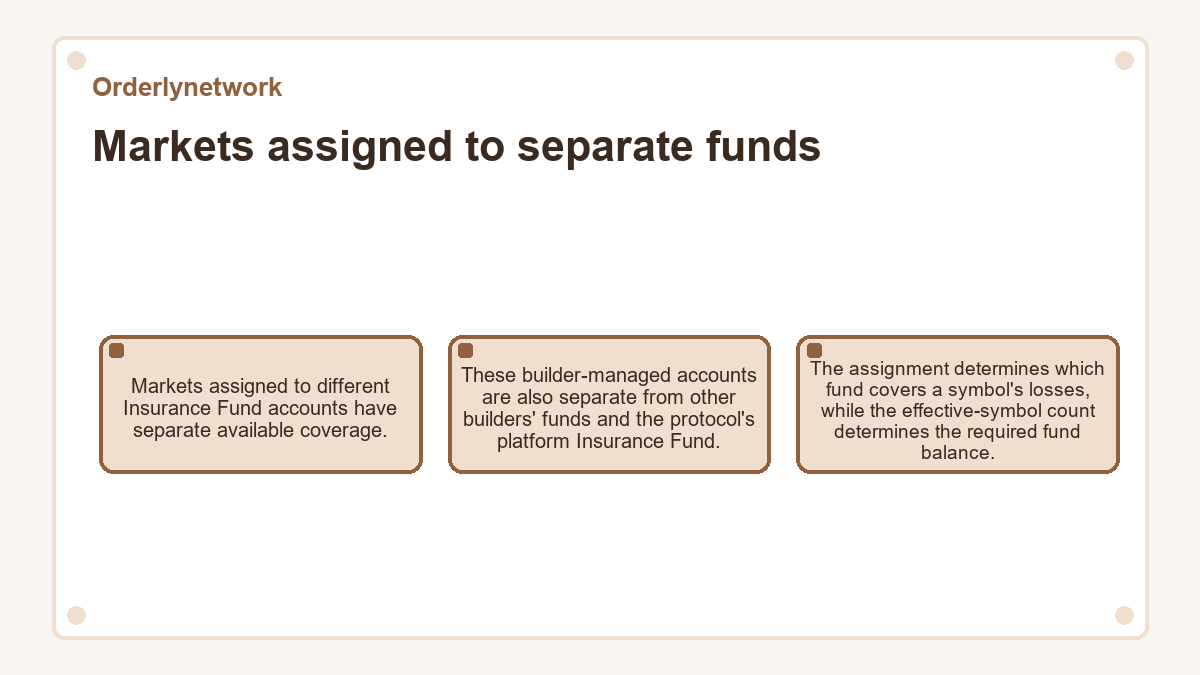
Markets assigned to separate funds
Markets assigned to different Insurance Fund accounts have separate available coverage. These builder-managed accounts are also separate from other builders' funds and the protocol's platform Insurance Fund. The assignment determines which fund covers a symbol's losses, while the effective-symbol count determines the required fund balance.
What happens when liquidity weakens after launch?
After launch, depth below Depth Warning signals thin liquidity, while depth below Depth Limit can trigger restrictions such as
REDUCE_ONLY
. The warning level can be breached while depth remains above the lower floor, so a Depth Warning alert alone doesn't establish that the market has entered the close-only
REDUCE_ONLY
state.
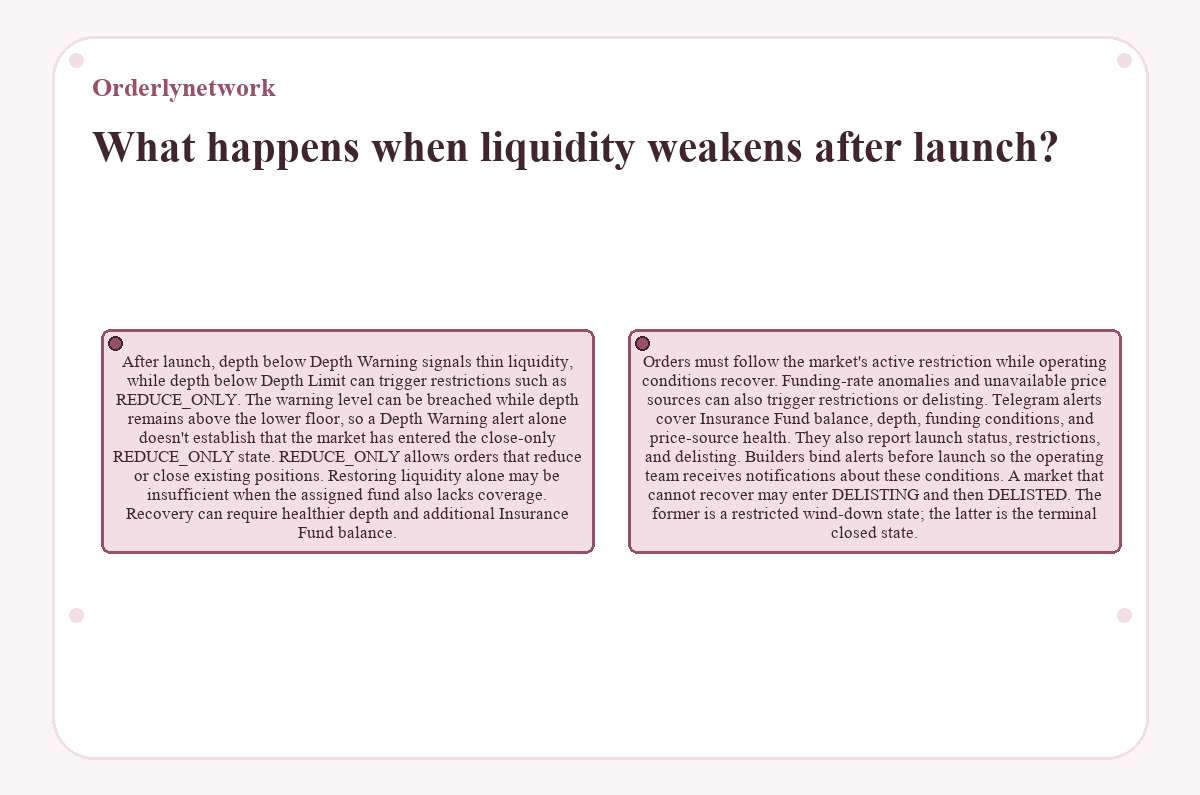
REDUCE_ONLY
allows orders that reduce or close existing positions. Restoring liquidity alone may be insufficient when the assigned fund also lacks coverage. Recovery can require healthier depth and additional Insurance Fund balance. Orders must follow the market's active restriction while operating conditions recover.
Funding-rate anomalies and unavailable price sources can also trigger restrictions or delisting. Telegram alerts cover Insurance Fund balance, depth, funding conditions, and price-source health. They also report launch status, restrictions, and delisting. Builders bind alerts before launch so the operating team receives notifications about these conditions.
A market that cannot recover may enter
DELISTING
and then
DELISTED
. The former is a restricted wind-down state; the latter is the terminal closed state.
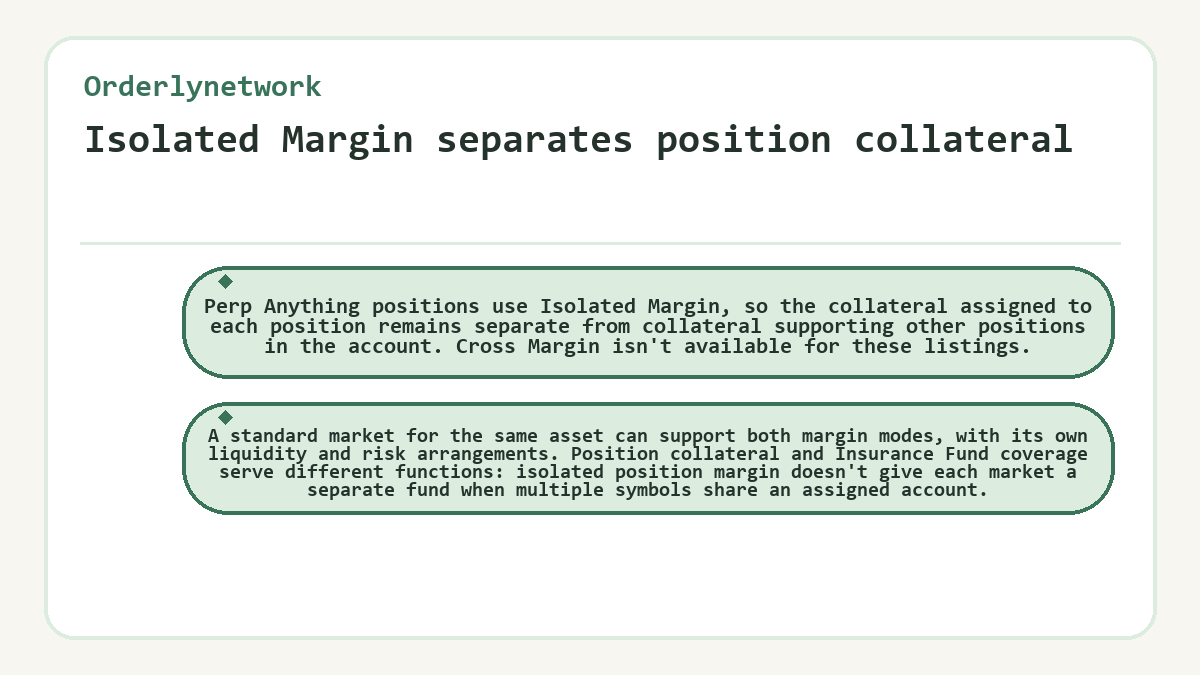
Isolated Margin separates position collateral
Perp Anything positions use Isolated Margin, so the collateral assigned to each position remains separate from collateral supporting other positions in the account. Cross Margin isn't available for these listings. A standard market for the same asset can support both margin modes, with its own liquidity and risk arrangements. Position collateral and Insurance Fund coverage serve different functions: isolated position margin doesn't give each market a separate fund when multiple symbols share an assigned account.
Community Listed symbols keep market identity distinct
A standard market and a builder-operated market for the same asset have separate symbols, orderbooks, liquidity, Insurance Funds, and risk parameters. Multiple builders can list the same underlying asset independently. Shared liquidity across supported chain connections doesn't merge these separate listings. Because their orderbooks are separate, depth in another symbol doesn't establish this market's launch readiness.
A supported interface displays the Community Listed symbol and its operating builder's name, identifying which market supplies the quoted liquidity. Spreads and depth depend on that builder's market-making arrangements and can differ from the standard market. A risk disclosure appears before the first trade in a Community Listed market. The shared matching and settlement infrastructure doesn't transfer operation or risk management of that listing to the protocol.
Price sources and trading sessions bound expansion
Builder-controlled price sources and supported trading sessions let Perp Anything accommodate different market needs, within the protocol's asset and risk-control rules. Pre-TGE listings enable price discovery before a token generation event. Builders can configure trading sessions for supported real-world asset markets. A price feed supplies a pricing input; configured parameters and operating conditions govern whether trading can open and remain active.
A builder can qualify for lower base fees through ORDER staking or monthly trading volume. These commercial tiers are separate from the liquidity and Insurance Fund conditions governing opening. An unavailable price source can still lead to trading restrictions even when both sides of a market meet their depth thresholds, because liquidity and source health remain separate operating conditions throughout its life.
Practical questions about Orderlynetwork
Which trading charges contribute to Perp Anything fee sharing?
Perp Anything fee sharing covers protocol base taker fees generated on the market. The default share is 50% on Mainnet and Testnet, although Orderlynetwork can set a different share for an individual builder. Maker fees, liquidation fees, and funding payments aren't included. This share concerns the protocol's base fee, not the entire trading fee that a frontend charges its users.
When does a builder receive the Perp Anything listing share?
The Perp Anything listing share is settled daily to the builder's DEX Admin account. Admin-account registration is required for the platform to receive its earnings. Daily revenue settlement doesn't defer risk controls until that payout: liquidations and other protective actions can execute when their own triggering conditions arise.
Do builders need a market-maker sub-account to launch a Perp Anything market?
Market-maker sub-accounts are optional for Perp Anything builders. These accounts can be bound to listed symbols to provide liquidity. Their optional status concerns the account arrangement, not the market's liquidity obligations. The builder remains responsible for arranging market-making that meets the applicable depth requirements and for responding when that liquidity deteriorates.
Does a Perp Anything market need more than one price source?
A Perp Anything market requires at least one valid Index Price source, while two or more sources are recommended. Builders select their price sources within the supported rules. Source availability remains an operating condition after launch, and unavailable sources can lead to trading restrictions.
How many Perp Anything markets can a builder operate?
A builder can have five Perp Anything markets by default, with the limit adjustable by Orderlynetwork. Markets in NEW, PENDING, POST_ONLY, ACTIVE, or REDUCE_ONLY count toward that limit. DELISTING and DELISTED markets don't. A restricted market therefore still occupies capacity even when it only allows position reductions.
What happens if a Community Listed market exhausts its Insurance Fund?
Auto-deleveraging is confined to positions in the affected market when its assigned Insurance Fund is depleted. Orderlynetwork doesn't backstop these builder-operated markets. This response differs from the platform backstop for standard markets. Market-scoped auto-deleveraging doesn't prevent losses from reducing the Insurance Fund balance available to other symbols assigned to the same account.
Will hiding a Community Listed symbol remove existing positions from the frontend?
Existing positions, orders, and trade history remain accessible when a frontend omits a Community Listed market from its picker. Frontends can show all Community Listed markets, select particular builders' markets, or omit them. That display choice concerns market discovery; it doesn't itself close existing positions or establish that the underlying market has been delisted.