 Orderlynetwork
 shared liquidity combines orders across supported chains in a common market orderbook
Orderlynetwork shared liquidity combines orders from supported chains in one orderbook for the same perpetual market. An off-chain engine matches orders, while vaults hold collateral and Orderly L2 records settlement. DEX interfaces can access common depth without separate books per chain. Perp Anything markets retain separate symbols and liquidity, including when their underlying asset matches a standard market.
Shared access gives builders an existing matching resource. Available depth follows the quotes in the selected market, and each frontend retains its own market selection and fee settings.
Shared liquidity connects supported chains within a market, while separate Community Listed symbols retain their own orderbooks and liquidity.
Quotes converge while vaults remain on their chains
A shared central limit orderbook (CLOB) gathers buy and sell interest from connected DEXs without creating a separate book for every supported chain. Resting quotes supply available quantities at particular prices. Orders from supported chains reach the same market's engine, although collateral sits in asset vaults on their respective chains. LayerZero carries messages for deposits, withdrawals, and balance updates between those vaults and the settlement system. Matching therefore doesn't require collateral to travel from one trader's chain to another for each execution.
Orderly L2 is the settlement ledger built with OP Stack. Matched trade data enters that ledger in batches. Each L2 batch or block publishes its corresponding data to Ethereum as calldata or blobs. Users don't interact with the settlement layer directly.
Do connected DEXs offer identical markets and fees?
Connected DEXs can access the same standard-market orderbook while presenting different market selections and charging different user fees. A builder chooses which supported symbols its interface displays. Another frontend may therefore expose a different set of markets even though both use Orderly's infrastructure.
The builder sets the trading fee that its users pay, subject to its tier's base fee. Traders pay a single configured fee per trade. Orderly's base fee belongs to the builder's cost structure. Trading fees are charged in USDC after each trade and reflected in the position's average entry price.
Available depth affects execution prices, while each frontend sets its user fees. Maker or taker classification also affects the applicable rate. Matching access alone doesn't establish an identical trading cost across DEXs.
Order instructions control exposure to the resting book
Order instructions govern whether submitted quantity can rest in the shared book, execute immediately, or remain limited to reducing an existing position. Those distinctions matter when unfilled interest should disappear after the matching attempt. IOC and FOK have explicit cancellation conditions; a plain limit order can leave quantity resting.
| Order instruction | Interaction with liquidity | Fill boundary |
|---|---|---|
| Limit | Adds liquidity while resting; can take liquidity on an immediate fill | Executes at its limit price or better |
| Market | Consumes available quotes immediately | Unfilled size cancels at book or price limits |
| IOC (Immediate or Cancel) | Matches available quantity immediately at the specified price | Any unfilled quantity is canceled |
| FOK (Fill or Kill) | Requires enough matching liquidity for the requested size | Entire size fills at the specified price, or the whole order is canceled |
| Post Only | Retains maker classification, including a match with hidden quantity only | Cancels if placement would immediately match visible quantity |
| Reduce Only | Liquidity role follows how the order fills | Can decrease an existing position only |
A cancellation rule concerns unfilled quantity under that instruction. Matched quantity has already become a trade, so canceling the remainder doesn't reverse its execution.
Price-time priority links quotes to fills
The off-chain matching engine uses price-time priority to process orders competing in the same book, regardless of their supported-chain entry point. The public book aggregates prices and quantities.
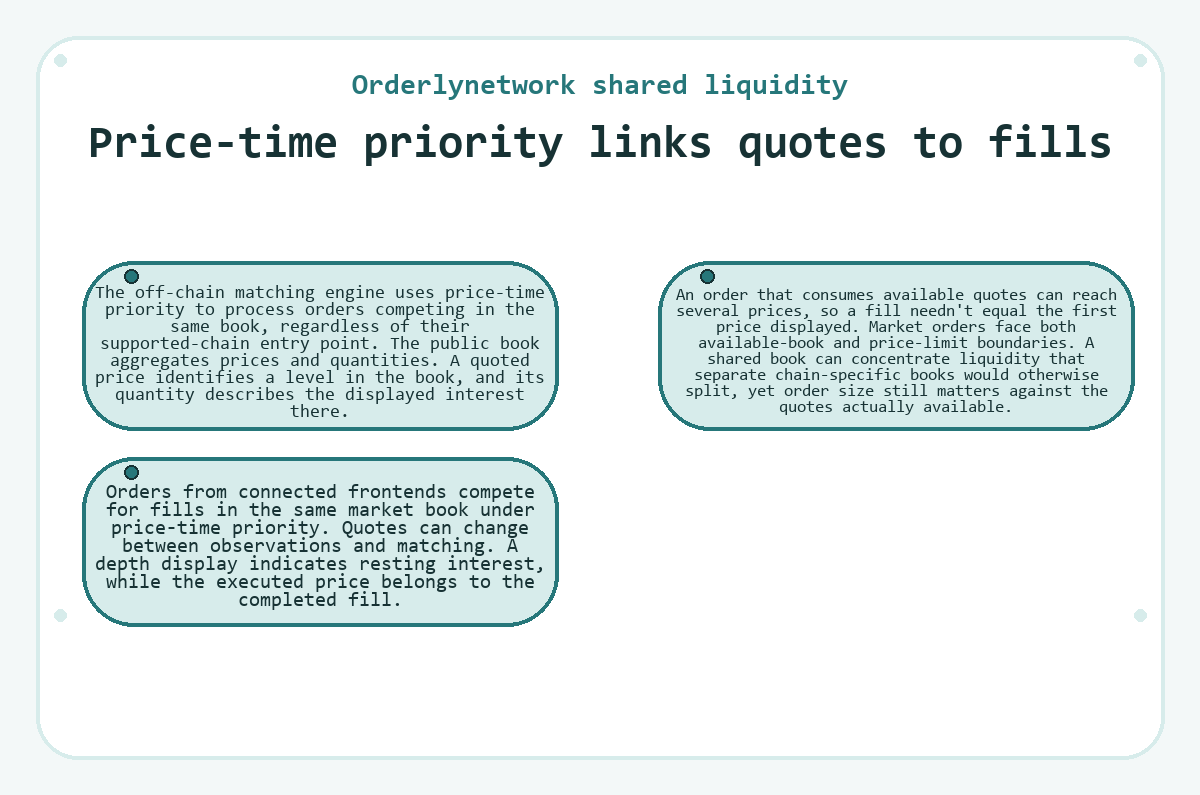
A quoted price identifies a level in the book, and its quantity describes the displayed interest there. An order that consumes available quotes can reach several prices, so a fill needn't equal the first price displayed. Market orders face both available-book and price-limit boundaries. A shared book can concentrate liquidity that separate chain-specific books would otherwise split, yet order size still matters against the quotes actually available.
Orders from connected frontends compete for fills in the same market book under price-time priority. Quotes can change between observations and matching. A depth display indicates resting interest, while the executed price belongs to the completed fill.
Collateral accounting stays separate from market depth
Collateral supports trading positions, whereas maker orders supply executable interest to the orderbook. Orderly perpetual contracts use USDC denomination and settlement. Eligible non-USDC collateral can also support positions under the multi-collateral system, subject to asset and chain eligibility, deposit caps, and collateral weights. The recognized collateral value can differ from the asset's full market value. Those accounting rules don't add bids or asks merely because assets have been deposited.
Cross margin shares collateral across cross-margin positions; isolated margin assigns it to a position. Standard markets support both. Community Listed markets use isolated margin only. A common matching resource doesn't merge those margin boundaries or replace collateral risk controls.
Community Listed symbols preserve distinct liquidity
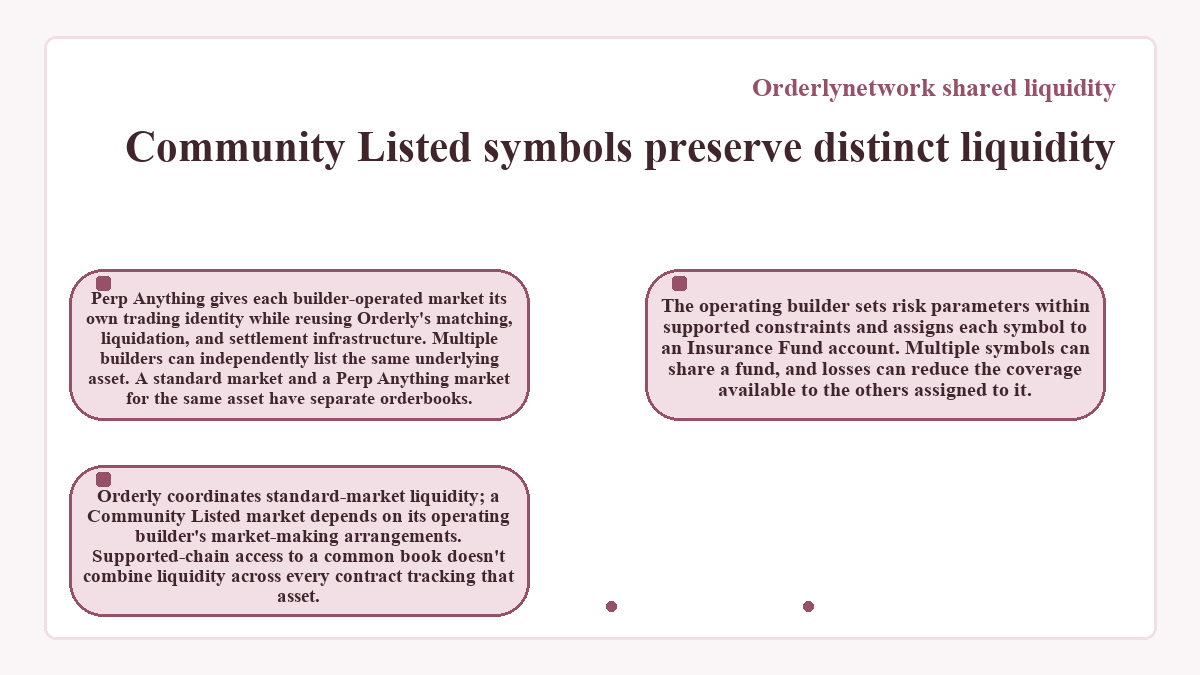
Perp Anything gives each builder-operated market its own trading identity while reusing Orderly's matching, liquidation, and settlement infrastructure. Multiple builders can independently list the same underlying asset. A standard market and a Perp Anything market for the same asset have separate orderbooks. The operating builder sets risk parameters within supported constraints and assigns each symbol to an Insurance Fund account. Multiple symbols can share a fund, and losses can reduce the coverage available to the others assigned to it. Orderly coordinates standard-market liquidity; a Community Listed market depends on its operating builder's market-making arrangements. Supported-chain access to a common book doesn't combine liquidity across every contract tracking that asset.
What can the public see before and after matching?
Public observers see aggregate resting prices and quantities before matching, then matched trade data after its inclusion on Orderly L2. The original order request goes to Orderly's off-chain infrastructure. Its operator and matching services can read the full request, including details that the public book doesn't show. Order requests use a Trading Key signature, which the system verifies before matching.
Order submission doesn't enter a public blockchain mempool before matching. That removes the opportunity to inspect that submission there and place a blockchain transaction ahead of it.
Operator visibility remains, and other forms of maximal extractable value (MEV) aren't ruled out. Following matching and L2 inclusion, public observers can inspect and decode the batch data when Ethereum publication becomes available.
Weak depth can restrict Community Listed trading
Thin liquidity affects executable quantity even when several supported chains connect to a market. In Perp Anything, liquidity monitoring examines bid and ask depth separately within the ±5% band. Falling below the applicable Depth Warning can produce an alert. A fall below Depth Limit can trigger restrictions such as REDUCE_ONLY. Those states belong to the affected market, so a trader can't infer full execution availability solely from seeing its symbol or from another market using the same underlying asset.
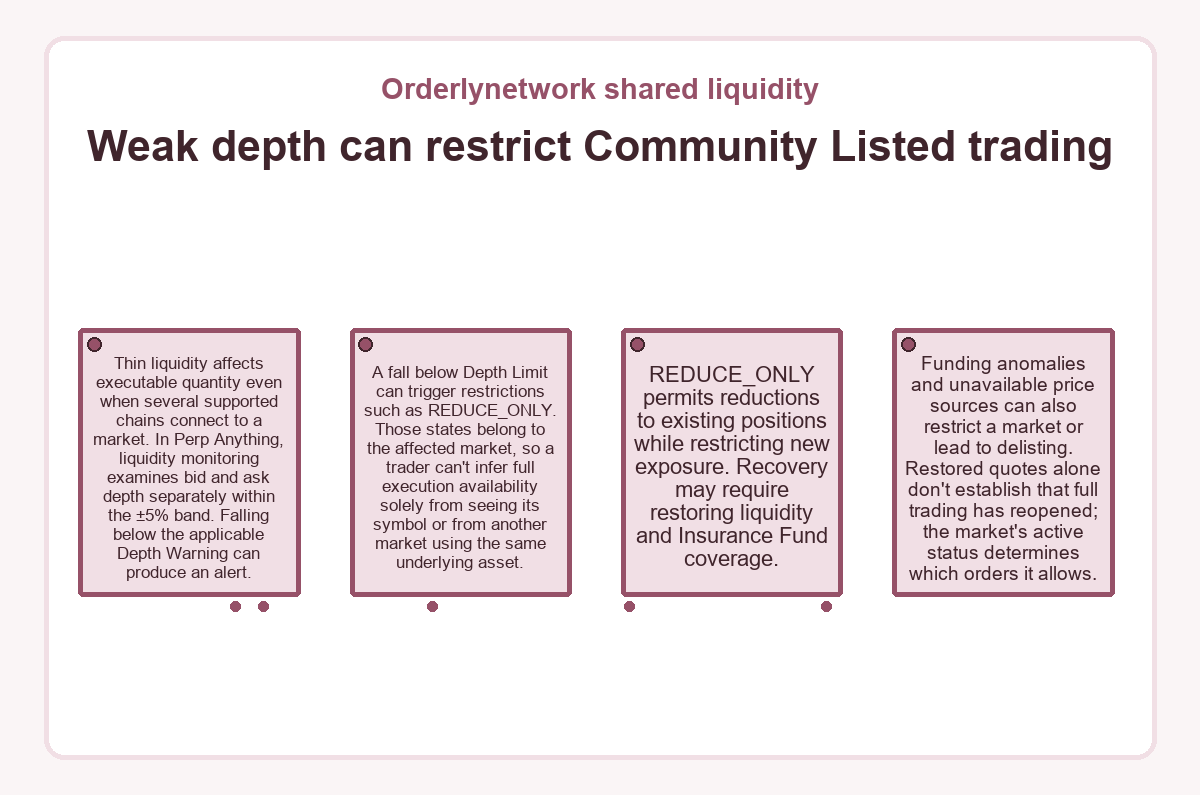
REDUCE_ONLY permits reductions to existing positions while restricting new exposure. Recovery may require restoring liquidity and Insurance Fund coverage. Funding anomalies and unavailable price sources can also restrict a market or lead to delisting. Restored quotes alone don't establish that full trading has reopened; the market's active status determines which orders it allows.
Orderlynetwork shared liquidity: common questions
Does choosing a custom DEX frontend create a separate orderbook?
A custom frontend built with Orderly's SDKs can use the same shared orderbook as the no-code launch path. Both integration paths connect a builder's DEX to shared infrastructure. Frontend customization changes the interface and user experience; it doesn't, by itself, create an independent liquidity pool for the same supported market.
Are unmatched quotes included in on-chain settlement data?
Settlement batches contain matched trade data, so unmatched or canceled quantities aren't recorded there as executed trades. A quote resting in the public book represents available trading interest. Its presence alone doesn't establish an execution. The matched portion becomes publicly observable after Orderly L2 inclusion, with corresponding batch data published to Ethereum.
Can opposite positions coexist on a market with shared liquidity?
Standard markets allow opposite positions on the same contract when one uses cross margin and the other uses isolated margin. Within either mode, positions are one-sided, so an opposite-direction order reduces or closes the existing position. The independent modes retain separate margin and liquidation prices. Perp Anything markets support isolated margin only.
Is a maker rebate automatic when a DEX uses shared liquidity?
Access to shared liquidity doesn't automatically entitle every maker fill to a rebate. Protocol funding requires a negative user-facing maker fee and remains capped by the builder's eligible tier. If the trader's maker fee is zero or positive, Orderly funds no rebate. The protocol-funded rebate belongs to the trader.
Does a fill in the shared orderbook transfer the underlying asset?
A perpetual fill gives exposure to a contract's price movement without transferring ownership of the underlying asset. Shared liquidity describes the orders available to match within that market. An equity- or commodity-linked perpetual remains a derivative, with collateral and settlement rules separate from ownership of the asset that its price tracks.