 Orderlynetwork
 staking earns VALOR for claims on protocol rewards
Orderlynetwork staking earns VALOR when eligible ORDER or esORDER remains staked in the protocol. VALOR measures participation in a reward treasury, and redemption burns the amount submitted for a payout. The system introduced on 4 November 2025 returns esORDER, which automatically stakes when claimed. Legacy VALOR can still claim USDC while its separate treasury remains funded. Holding VALOR, requesting redemption, and claiming rewards therefore represent different states, with settlement required before a payout becomes available.
Bottom line: A submitted VALOR redemption can't be canceled, and rewards from the newer system become staked esORDER when claimed.
Staked balances establish eligibility for VALOR accrual
Staking ORDER or esORDER provides the balance that determines participation in VALOR emissions. Successful ORDER staking increases the recorded stake and begins accrual immediately. Simply holding ORDER in a connected wallet doesn't create that staking position. VALOR accrues each second in proportion to your share of total staked ORDER and esORDER. Your accumulated balance depends on that share and staking duration.
The ledger connects assets with reward accounting
ORDER and esORDER provide the stake
ORDER is the protocol token, and esORDER is its escrowed form. Both can earn VALOR through staking. Their different liquidity properties matter when withdrawing value: esORDER requires vesting to become liquid ORDER. The Omnichain Ledger manages staking, vesting, withdrawals, and VALOR redemption. Proxy contracts support interaction from different EVM chains through cross-chain messaging. For a given EVM address, staking information remains consistent across supported networks, while the wallet's ORDER balance belongs to its particular network. This separates the protocol's participation record from tokens held locally in the wallet.
VALOR records accumulated participation
VALOR is a non-transferable accounting metric tied to stake amount and duration. It isn't an asset that holders can buy, sell, or move between wallets. Its role is to measure entitlement to the relevant treasury, using the balance accumulated through staking.
Net fees fund the new treasury while legacy USDC remains separate
The reward system effective from 4 November 2025 directs 30% of protocol net fees to the staking treasury. Fees accrue daily, and an ORDER buyback settles that allocation at each epoch's end. The resulting rewards take the form of esORDER.
Orderly-powered decentralized exchanges generate trading activity through the shared liquidity infrastructure. On taker trades, builders retain the margin between their user fee and Orderly's base fee. Builders' fee margins are separate from the protocol net fees that fund the staking treasury.
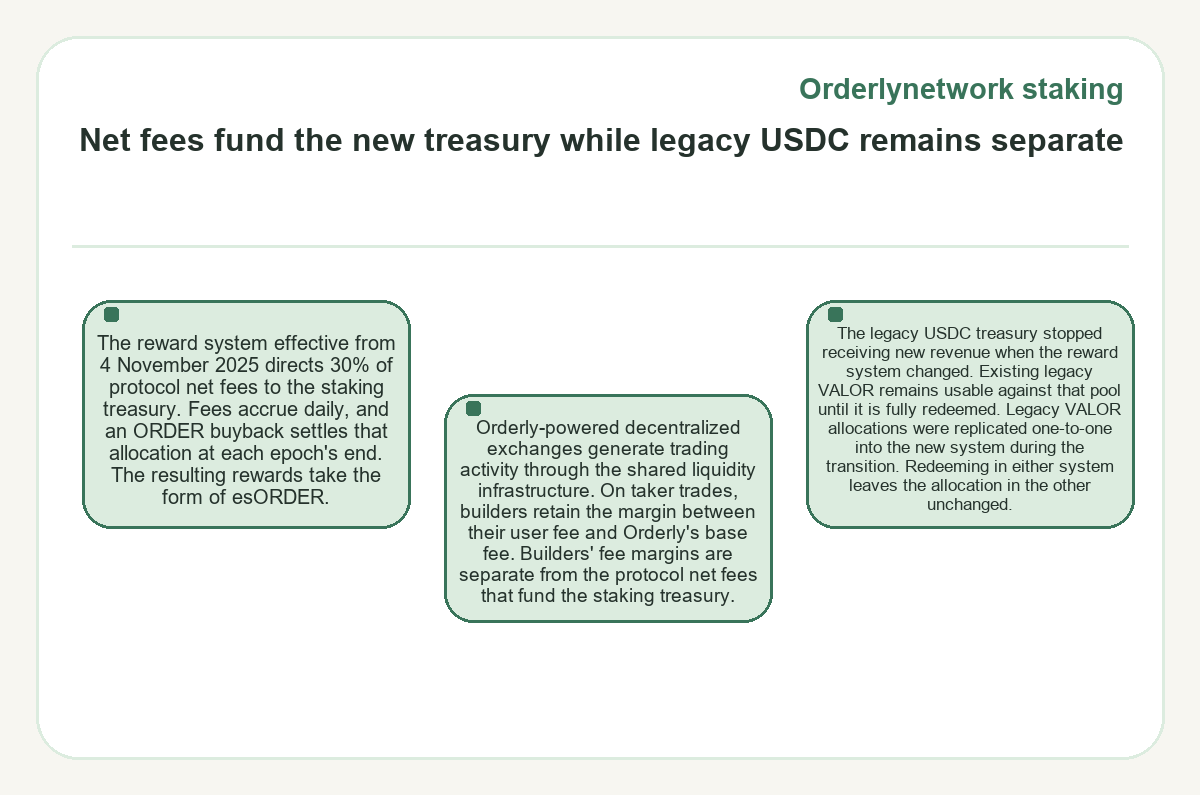
The legacy USDC treasury stopped receiving new revenue when the reward system changed. Existing legacy VALOR remains usable against that pool until it is fully redeemed.
Legacy VALOR allocations were replicated one-to-one into the new system during the transition. Redeeming in either system leaves the allocation in the other unchanged.
How does a VALOR balance determine the reward amount?
A VALOR reward amount follows the submitted balance's proportion of circulating VALOR in the same system, multiplied by that system's treasury value. Circulating VALOR equals total emissions to date minus amounts burned through redemption. For a partial redemption, the submitted amount determines the portion being exchanged, while the remaining available balance retains its treasury participation.
Redeeming VALOR permanently burns the redeemed amount. That burn reduces the circulating denominator, while the payout removes the corresponding treasury backing. A smaller denominator alone doesn't establish that remaining holders received a larger asset allocation.
Continued emissions can dilute an unchanged VALOR balance as other stakers accrue more. New treasury funding can increase backing, while payouts reduce the pool. These changes explain why an accumulated metric doesn't lock in a future reward amount. Retaining VALOR in the newer system preserves participation in future revenue, with its value governed by treasury assets and circulating supply.
Redemptions within the same epoch use one batch-end VALOR price. Submission therefore commits an amount before the final batch valuation. Partial and full redemptions are supported, and a submitted request can't be revoked. The legacy pool's valuation ratio remains fixed because that pool no longer receives new revenue.
Batch closure starts the reward waiting period
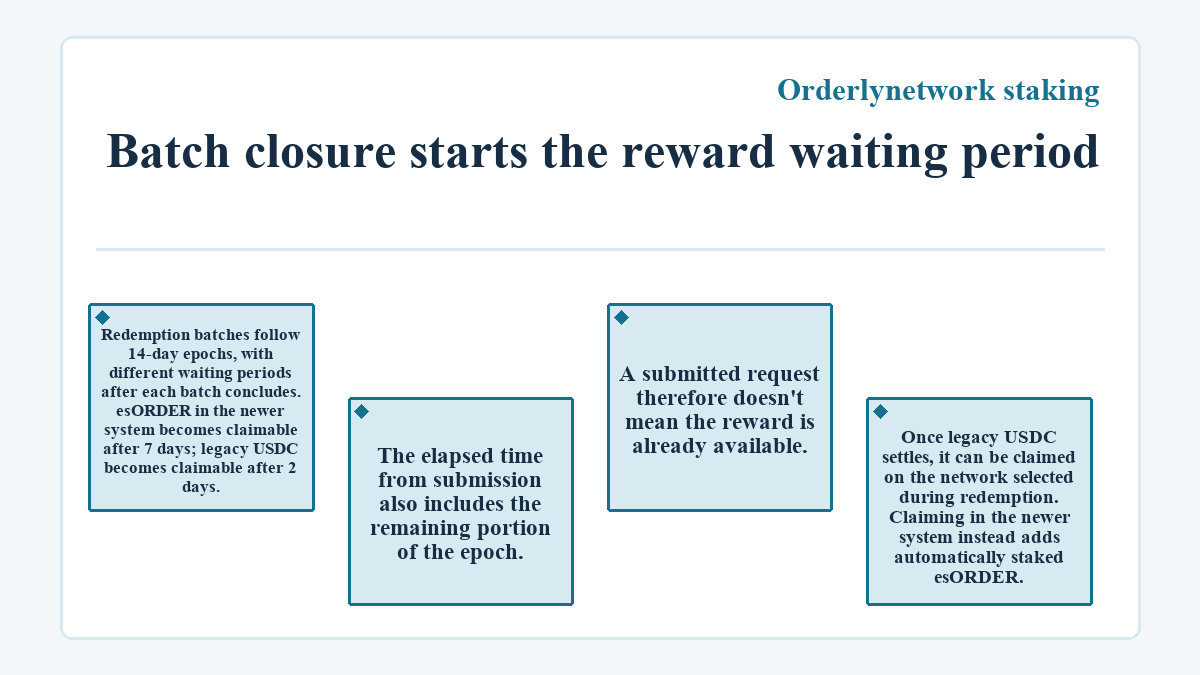
Redemption batches follow 14-day epochs, with different waiting periods after each batch concludes. esORDER in the newer system becomes claimable after 7 days; legacy USDC becomes claimable after 2 days. The elapsed time from submission also includes the remaining portion of the epoch. A submitted request therefore doesn't mean the reward is already available. Once legacy USDC settles, it can be claimed on the network selected during redemption. Claiming in the newer system instead adds automatically staked esORDER.
When can esORDER rewards become liquid ORDER?
Claimed esORDER becomes liquid ORDER through vesting, with a 50% conversion at 15 days and full conversion at 90 days. Claiming the staking reward first puts esORDER into stake, where it immediately earns VALOR. Obtaining transferable ORDER requires the separate vesting choice. Those operations affect different balances and shouldn't be treated as the same withdrawal.
Vesting duration determines the conversion percentage
The conversion percentage increases linearly between day 15 and day 90. Only one claim is available within that window. If esORDER is redeemed before the full vesting period, the unconverted portion is permanently burned. An early claim therefore changes how much liquid ORDER the escrowed balance returns, even when the initial esORDER amount is unchanged. This burn concerns the unconverted ORDER allocation associated with esORDER vesting. VALOR redemption burns a different accounting balance.
ORDER unstaking uses a separate release period
Unstaking already-staked ORDER starts a 7-day release period. The tokens being unstaked stop accruing VALOR, while previously earned VALOR remains intact. That retained balance stays exposed to dilution as other participants earn new emissions. After the release period, you can claim the unstaked ORDER on your connected supported network. VALOR redemption exchanges an accumulated treasury entitlement.
The intended payout determines the redemption decision
Before committing a treasury claim
An available VALOR balance and a pending redemption represent different claims on rewards. Before committing a request, identify which allocation it spends and how the resulting payout will become usable.
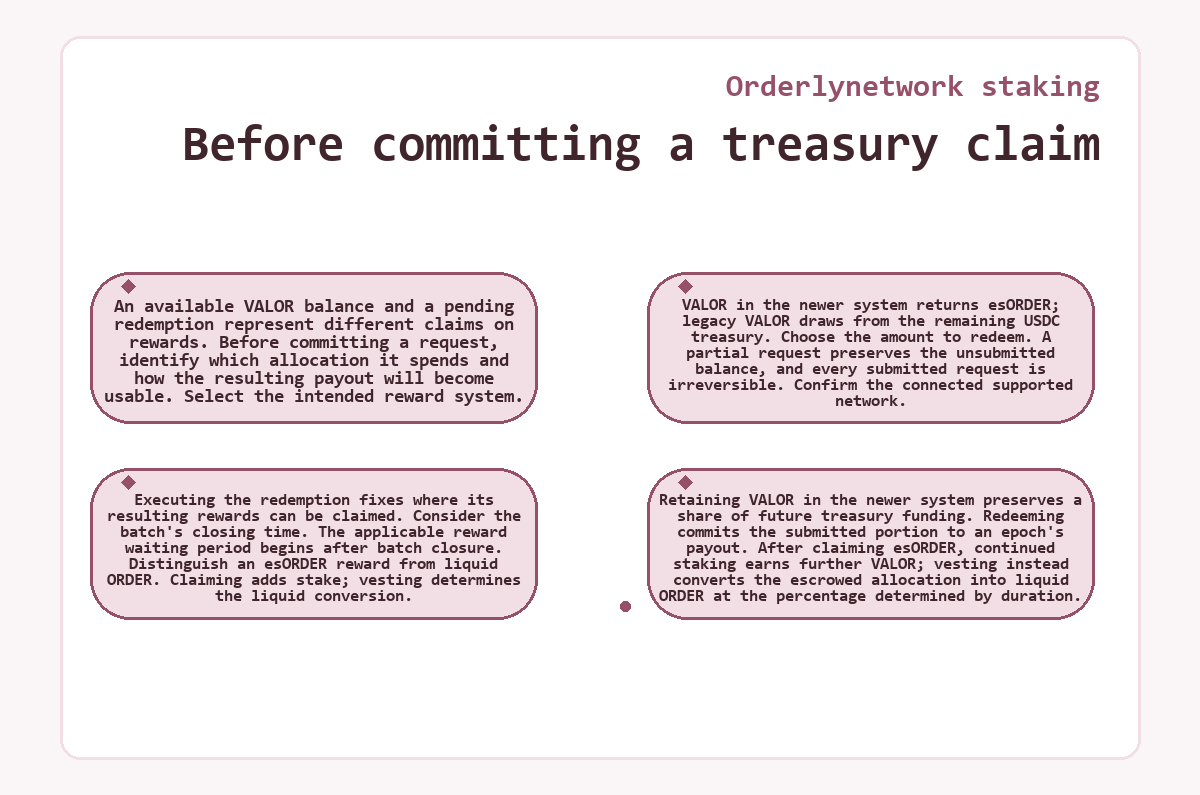
- Select the intended reward system. VALOR in the newer system returns esORDER; legacy VALOR draws from the remaining USDC treasury.
- Choose the amount to redeem. A partial request preserves the unsubmitted balance, and every submitted request is irreversible.
- Confirm the connected supported network. Executing the redemption fixes where its resulting rewards can be claimed.
- Consider the batch's closing time. The applicable reward waiting period begins after batch closure.
- Distinguish an esORDER reward from liquid ORDER. Claiming adds stake; vesting determines the liquid conversion.
Retaining VALOR in the newer system preserves a share of future treasury funding. Redeeming commits the submitted portion to an epoch's payout. After claiming esORDER, continued staking earns further VALOR; vesting instead converts the escrowed allocation into liquid ORDER at the percentage determined by duration.
Orderlynetwork staking: what people ask
Are locked team and investor tokens eligible for staking rewards?
Locked team and investor allocations can't be staked while they're locked. That exclusion concerns those allocations, rather than esORDER's separate ability to earn VALOR through staking.
Does another ORDER unstaking request extend the waiting period?
A new ORDER unstaking request merges with the existing request and restarts the 7-day waiting period for the combined amount. Only one active request is allowed, so the amount already waiting also follows the new release date.
Will canceling unstaking restore the VALOR I missed?
Canceling ORDER unstaking resumes VALOR accrual without restoring rewards for the time spent unstaking. Cancellation during the 7-day period restakes the full amount.
Can I submit VALOR redemptions from several supported networks?
Multiple VALOR redemption requests can be submitted across supported networks. Each request assigns its rewards to the network connected during execution. Switching networks afterward doesn't redirect an existing claim; separate requests retain their respective claim networks.
How is the displayed staking APR calculated?
The displayed annual percentage rate, or APR, annualizes the protocol's trailing 7-day average daily returns. Daily returns equal 30% of protocol daily net revenue divided by the USD value of all staked ORDER and esORDER. Revenue and stake valuation therefore affect the calculation.